2026 PACIFIC CASCADE REGION SUMMER WILDLAND FIREFIGHTER
State of Washington
StalePosted Nov 14

Posted: November 14, 2025 (62 days ago)
Added to FreshGovJobs: December 5, 2025 (41 days ago)
This job has been posted for over a month. It may already be filled.
State of Washington
Dept. of Natural Resources
This seasonal job involves leading a small team of 3-4 firefighters on wildland fire engines in Washington's Pacific Cascade Region, focusing on preparing for fires, suppressing them when they occur, and maintaining equipment and vehicles.
When not fighting fires, the role includes tasks like tree thinning, brush clearing, and site maintenance to protect natural resources.
It's ideal for someone physically fit, reliable, and eager to gain hands-on leadership experience in outdoor conservation work, with a passion for teamwork in challenging conditions.
.png)
The Engine Leader performs a leadership role within a crew. Candidates are required to have 3 months of previous natural resource work experience.
Engine Leader duties may include:Supervising and/or leading crews on the fire line, fire suppression and prevention, operating and maintaining small motorized equipment, and operating light or heavy trucks (e.g., 1-ton 4x4, 400 gal., 3-4 person fire engine).
Many of the duties performed on these jobs require considerable physical exertion, working outdoors in all terrain and weather conditions, working long hours, and extended periods away from home.
Duties include, but may not be limited to, the ability to carry up to 60 pounds, run, bend, twist, walk, and/or climb.
Engine Leaders are required to have a basic fundamental understanding of the Wildland Fire Management activities, including Fire Suppression, Mitigation, and Prevention.
This knowledge and skill sets are achieved through successful demonstration and practical experience working for one or more fire years as Wildland Firefighters.
Additionally, a fundamental understanding of wildland firefighting strategy and risk management is required to look out for the safety of fire responders and the public.
Must pass the DNR work capacity test or "Pack Test" during the selection process and before starting work.
The "Pack Test" is a work capacity test that measures aerobic capacity, muscular strength, and muscular endurance (45lbs, 3 miles within 45 minutes), as well as pass an Annual Refresher (RT-130).
A valid driver’s license and two years of driving experience.
Additionally, DNR requires state drivers to possess a license that is not suspended, revoked, or restricted (for example, Occupational/Restricted Driver Licenses or requiring ignition interlock devices).
This position requires driving as an essential function.
Finalists and/or interview candidates will be asked to provide a driving record from all states in which they have held a license during the past two years.
Field duties require the use of hand tools, power tools, GPS, topographic maps, a compass, and an iPad.
Must be able to carry appropriate wildland fire tools on field assignments, as needed, to conduct assigned tasks.
Day-to-day responsibilities require the ability to safely operate pickup trucks and larger Type 5 Wildland Fire Engines.
Desired Qualifications:PRIOR to reporting to the Pack Test, you will be required to turn in a completed Waiver and Release Form and a completed Health Screening Questionnaire (HSQ).
Applicants are strongly encouraged to train for the arduous-level work capacity test.
However, before you begin to train for testing or before substantially increasing your level of activity, please review the health screening questionnaire (HSQ) and consult your health care provider if necessary.
You may contact DNR Recruiting at DNRRecruiting@dnr.wa.gov for a copy of the HSQ.
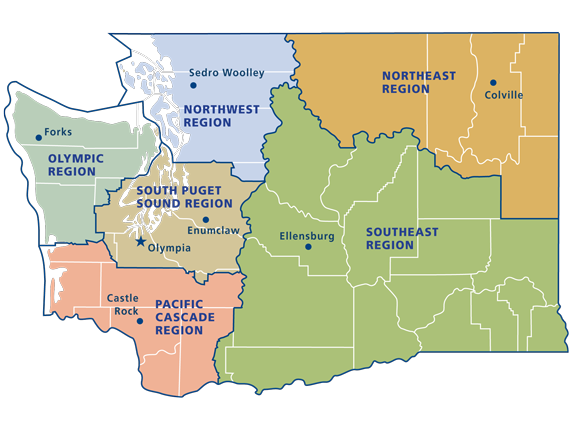
Work Locations:North Fire UnitThe North Unit is spatially the largest unit, encompassing Lewis, Pacific, and a portion of South Grays Harbor counties.
As such the unit ranges from scrub forests and sand dunes of the coast to the foothills of the Cascade Mountain range.
The unit is primarily composed of private and public timberlands, generally supported by rural communities but also home to several larger municipalities such as Centralia, Chehalis, and Raymond Washington.
The unit houses 7 engine crews out of 3 duty stations, Chehalis, Menlo, and Naselle. Limited housing is available on-site at Menlo, and five full hook-up RV sites available in Chehalis.
Four bedrooms available off-site in Toledo.
All housing will be assigned on an as-needed basis and is not guaranteed.Unit Contacts:Tanner Stemkoski – FMO - Tanner.Stemkoski@dnr.wa.govJerrit Chenier – AFMO - Jerrit.Chenier@dnr.wa.govCentral Fire UnitThe Central Unit is home to the Region Headquarters (Castle Rock) and connects the North and South Unit.
As such Central Unit is commonly called upon to assist the North and South Units in addition to its fire suppression load.
Central Unit is located in Cowlitz and Wahkiakum counties, the unit houses 6 engine crews with duty stations in Kalama, Castle Rock, and Kelso/Longview Washington.
No agency housing or RV hook-ups and parking is available, however private accommodations are available throughout the area.Unit Contacts:Josh Mohler – FMO - Josh.Mohler@dnr.wa.govBrandon Blodgett – AFMO - Brandon.Blodgett@dnr.wa.govCameron Stewart – AFMO - Cameron.Stewart@dnr.wa.govSouth Fire UnitThe South Unit has the smallest occurrence of protected lands, due in large part to the amount of federally protected lands.
However, the south has the greatest population levels as it is within commuting distance to the Portland Metro Area and therefore has the largest amount of Wildland Urban Interface and public interaction.
South Unit is located in Clark and Skamania Counties, and houses 6 engine crews out of Battle Ground and North Bonneville Washington.
No agency housing is available, however private accommodations are readily available.Unit ContactsTrent Crossland – FMO - Trenton.Crossland@dnr.wa.govKasey Bond – AFMO - Kasey.Bond@dnr.wa.govDave Hubbard – AFMO - Dave.Hubbard@dnr.wa.govFor more specific information about DNR Uplands Regions and how to contact those regions, please visit http://www.dnr.wa.gov/about/dnr-regions-and-districts
About the Department of Natural Resources (DNR).
Our mission is to manage, sustain, and protect the health and productivity of Washington’s lands and waters to meet the needs economically and socially for current and future generations.
At DNR, we approach our work through the lens of making Washington a better place environmentally and are dedicated to serving Washington’s lands and communities through diversity, equity, and inclusion.
With nearly 1,500 employees in locations throughout Washington, we manage and protect more than 5 million acres of state-owned forest, range, commercial, agricultural, and aquatic lands.
 Additional Information:
 Check your resume before applying to catch common mistakes