2026 NORTHWEST REGION SUMMER WILDLAND FIREFIGHTER
State of Washington
StalePosted Nov 14

Posted: November 14, 2025 (62 days ago)
Added to FreshGovJobs: December 5, 2025 (41 days ago)
This job has been posted for over a month. It may already be filled.
State of Washington
Dept. of Natural Resources
This seasonal job involves leading a small team of 3-4 firefighters on wildland fire engines, handling fire suppression, prevention tasks, and maintaining equipment during Washington's summer fire season, which typically lasts 3-6 months from May to September.
It's physically demanding work with long hours outdoors, often away from home, but offers training and chances to build skills in natural resources.
A good fit would be someone reliable, hardworking, with prior outdoor experience who enjoys teamwork and wants to start a career in firefighting or forestry.
.png)
The Engine Leader performs a leadership role within a crew. Candidates are required to have 3 months of previous natural resource work experience.
Engine Leader duties may include:Supervising and/or leading crews on the fire line, fire suppression and prevention, operating and maintaining small motorized equipment, and operating light or heavy trucks (e.g., 1-ton 4x4, 400 gal., 3-4 person fire engine).
Many of the duties performed on these jobs require considerable physical exertion, working outdoors in all terrain and weather conditions, working long hours, and extended periods away from home.
Duties include, but may not be limited to, the ability to carry up to 60 pounds, run, bend, twist, walk, and/or climb.
Engine Leaders are required to have a basic fundamental understanding of the Wildland Fire Management activities, including Fire Suppression, Mitigation, and Prevention.
This knowledge and skill sets are achieved through successful demonstration and practical experience working for one or more fire years as Wildland Firefighters.
Additionally, a fundamental understanding of wildland firefighting strategy and risk management is required to look out for the safety of fire responders and the public.
Must pass the DNR work capacity test or "Pack Test" during the selection process and before starting work.
The "Pack Test" is a work capacity test that measures aerobic capacity, muscular strength, and muscular endurance (45lbs, 3 miles within 45 minutes), as well as pass an Annual Refresher (RT-130).
A valid driver’s license and two years of driving experience.
Additionally, DNR requires state drivers to possess a license that is not suspended, revoked, or restricted (for example, Occupational/Restricted Driver Licenses or requiring ignition interlock devices).
This position requires driving as an essential function.
Finalists and/or interview candidates will be asked to provide a driving record from all states in which they have held a license during the past two years.
Field duties require the use of hand tools, power tools, GPS, topographic maps, a compass, and an iPad.
Must be able to carry appropriate wildland fire tools on field assignments, as needed, to conduct assigned tasks.
Day-to-day responsibilities require the ability to safely operate pickup trucks and larger Type 5 Wildland Fire Engines.
Desired Qualifications:PRIOR to reporting to the Pack Test, you will be required to turn in a completed Waiver and Release Form and a completed Health Screening Questionnaire (HSQ).
Applicants are strongly encouraged to train for the arduous-level work capacity test.
However, before you begin to train for testing or before substantially increasing your level of activity, please review the health screening questionnaire (HSQ) and consult your health care provider if necessary.
You may contact DNR Recruiting at DNRRecruiting@dnr.wa.gov for a copy of the HSQ.
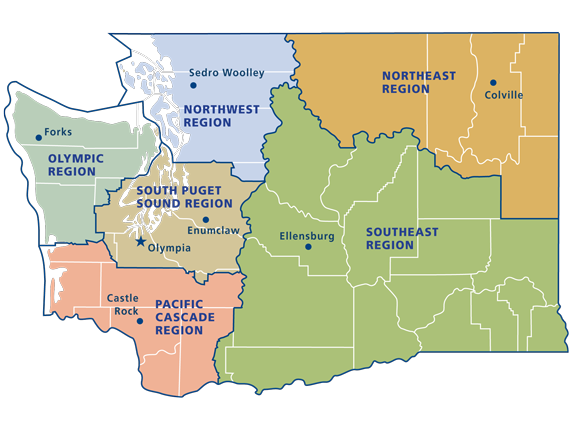
Work Locations:The Northwest Region covers wildland fire protection, regulation, and prevention from the area just north of the greater Seattle (Snohomish/King County line), to the Canadian border, including Whidbey, Camano, and the San Juan Islands on the west to the Cascade Mountain crest on the east.
Wildland fire protection ranges from industrial forestlands to conservation landscapes, to the Wildland Urban Interface located in the developed rural and municipal communities.
Engine Crews work out of pre-determined rendezvous points strategically scattered throughout Snohomish, Skagit, and Whatcom Counties to provide for fire protection response throughout the whole region and to accommodate the most efficient meeting locations for firefighters that live across a wide array of locations.
Northwest Region consists of two Fire Units.North ZoneThe Kulshan Fire Unit covers all of Whatcom and the majority of Skagit Counties. The North Zone staffs 5 four-person Engine Crews.
Engine Crews are desired to work out of the following pre-determined locations: Deming, Bellingham general area, Alger general area, Sedro-Woolley to Concrete general area.
In the application questions, please specify your preference and/or availability of work locations within the North Zone Fire Unit.
Housing may be available on a limited basis for this location.South Zone The Salish Fire Unit covers all of Snohomish, Island, San Juan, and the southern portion of Skagit Counties.
The South Zone staffs 5 four-person Engine Crews.
Engine Crews are desired to work out of the following pre-determined locations: Monroe to Snohomish general area, Arlington to Darrington general area, Sedro-Woolley to Big Lake general area, and Burlington to Anacortes general area.
In the application questions, please specify your preference and/or availability of work locations within the South Zone Fire Unit. No housing is available for this location.Questions?
Please contact the Northwest Region office at Northwest.region@dnr.wa.gov or 360-856-3500.
For more specific information about DNR Uplands Regions and how to contact those regions, please visit http://www.dnr.wa.gov/about/dnr-regions-and-districts
About the Department of Natural Resources (DNR).
Our mission is to manage, sustain, and protect the health and productivity of Washington’s lands and waters to meet the needs economically and socially for current and future generations.
At DNR, we approach our work through the lens of making Washington a better place environmentally and are dedicated to serving Washington’s lands and communities through diversity, equity, and inclusion.
With nearly 1,500 employees in locations throughout Washington, we manage and protect more than 5 million acres of state-owned forest, range, commercial, agricultural, and aquatic lands.
 Additional Information:
Check your resume before applying to catch common mistakes